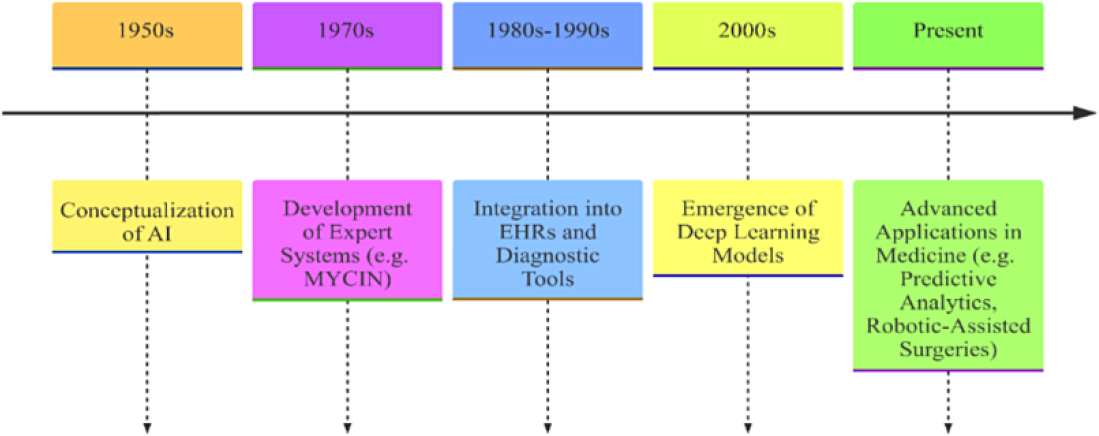
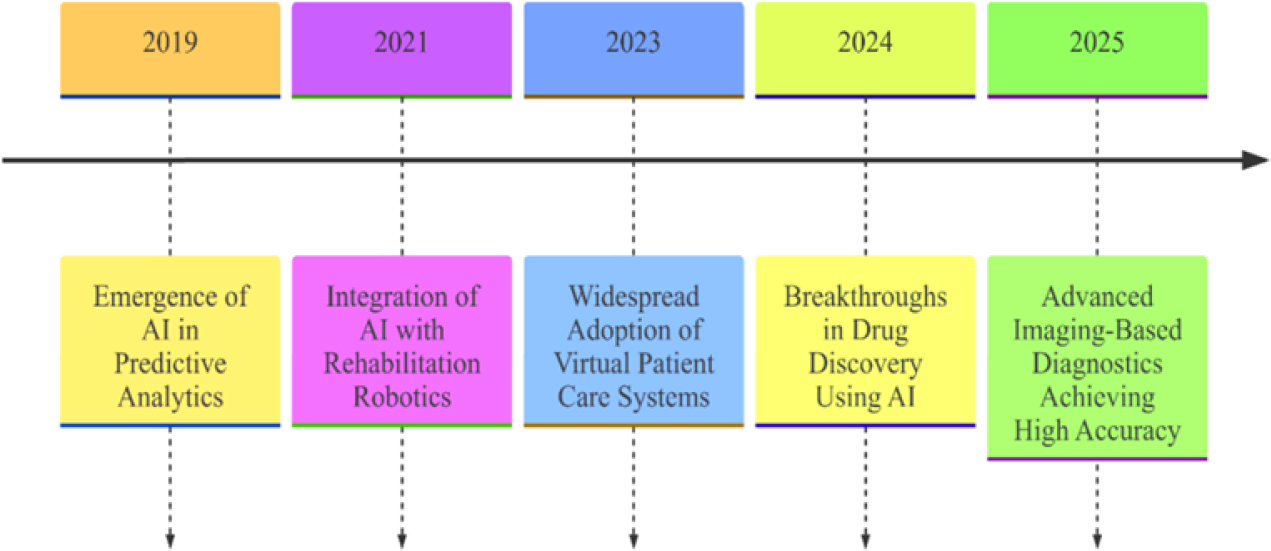
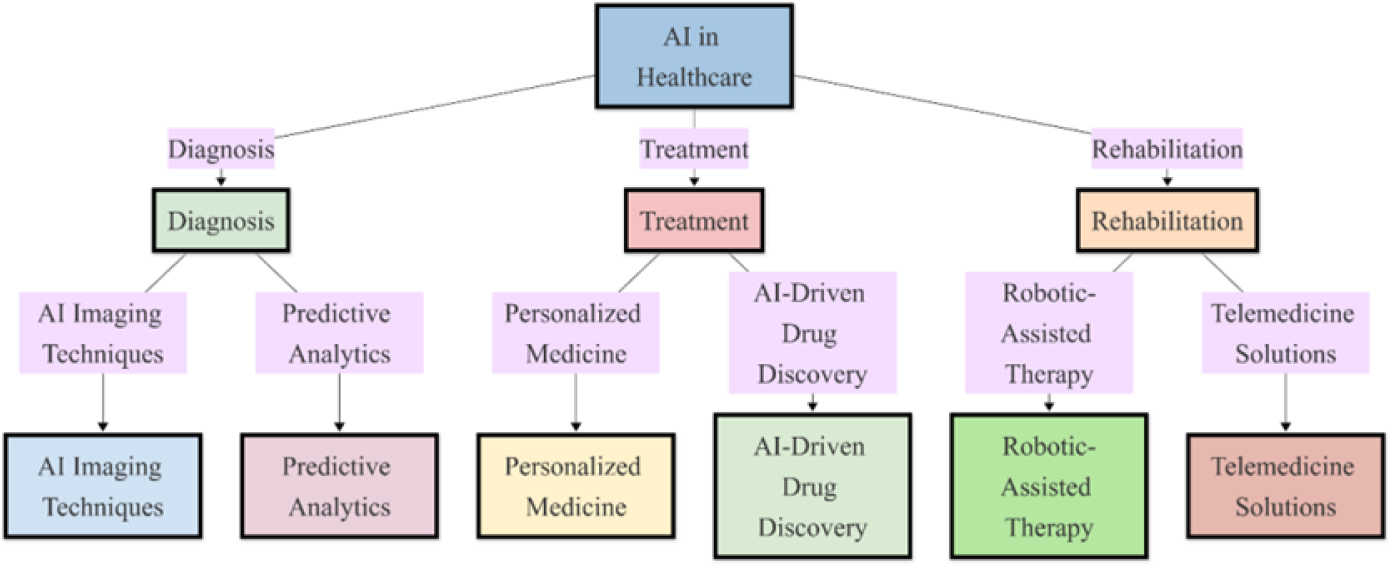
Artificial intelligence (AI) is revolutionizing contemporary healthcare with revolutionary diagnosis, treatment and rehabilitation. The inclusion of AI in physiotherapy and oncology is approached in this chapter, firstly focusing on how it could improve diagnostics, personalize treatments and optimize rehabilitation. It starts with a primer on AI, defines it and discusses the history of AI’s development in the medical field. A literature survey shows current trends and compares AI methodologies applied towards physiotherapy and oncology. In this section, we outline the research design and data collection approach used to investigate AI-enabled health innovation. We will talk about AI’s potential to transform healthcare by increasing diagnostic accuracy, predicting disease to prevent it and personalizing treatment to an individual’s needs. This chapter also examines the use of AI in medical fields, early cancer detection based on AI imaging and tailor-made rehabilitation programs for the restoration of mobility. This chapter also looks into the advantages of AI, including better patient outcomes, efficiency of care delivery and cost-effectiveness. Ethical aspects, such as data privacy and algorithmic bias, are discussed, and future perspectives on AI technologies, such as robotics and wearables in predictive medicine, are included. This chapter ends by envisioning the future of AI in healthcare, where technology and compassion meet to redefine patient outcomes from diagnosis to recovery. Healthcare is experiencing an artificial intelligence (AI) revolution. AI is transforming how diseases are diagnosed, treated, and managed, enabling: Healthcare is an AI revolution. It will have a revolutionary impact on the healthcare industry by providing new diagnostic and therapeutic concepts and rehabilitation ideas for medical care (Shrivastava et al. 2025). Its integration into the clinic has set the stage for precision medicine, personalized medicine and improved resource use. The chapter begins with an overview of some healthcare AI that provides a perspective on a couple of applications in both physiotherapeutic and oncological settings as an example of two significant areas of patient care. AI is the development of computer systems that can perform tasks that would require human intelligence, such as learning, reasoning and self-correction. Examples found in the health industry include machine learning (ML), natural language processing (NLP) and computer vision applied to interpret complicated medical records. Such systems aid in the diagnosis of diseases, in predicting prognoses and in prescribing individualized treatment (Sonar 2025). For example, AI ML algorithms could scour vast electronic health records (EHRs) for patterns that improve diagnostic accuracy or predict disease progression. AI is also being widely used in drug discovery, analysis of medical images and in tracking patients remotely, offering an opportunity to enhance patient care and cut out inefficiencies from operations. The history of AI in medicine demonstrates many decades of technological progress. Early work started in the 1950s with the idea of ML algorithms that could work on simple computational problems (Singh 2025). During the 1970s, expert systems such as MYCIN were created to guide doctors in diagnosing bacterial infections and suggesting subsequent treatments. AI was introduced in EHRs during the 1980s and 1990s, making data-driven clinical system decisions possible. Figure 17.1. Timeline of AI’s evolution in healthcare. Things changed significantly once deep learning (DL) models were introduced in the early 2000s, which could make sense of complex data, like medical images used to detect diseases, where utility has been demonstrated in starch AI for predicting robotic-assisted surgeries and real-time patient monitoring. Figure 17.1 shows major milestones in the evolution of AI in healthcare. It all began with the rise of AI technology in the 1950s, and continued to the time of AI expert systems like MYCIN in the 1970s. The use of AI in EHRs in 1980–1990s was a milestone in evidence-based health practice. It was not until the early 2000s that more powerful models such as DL ones came into existence, capable of interpreting complex datasets (such as the medical images used to detect diseases). Not to mention, advisable use-cases now include sophisticated tech such as predictive analytics and robot-assisted surgery. They are transformational in terms of how care is being delivered in healthcare. Figure 17.1 presents a short history of AI alongside a timeline of its increasing relevance to changing healthcare practice. From diagnoses that are more accurate to individualized treatment plans, AI is revolutionizing the way the medical industry is using and looking at patient care (Chatzivasileiou et al. 2025). AI is a disruptive force in healthcare and has been increasingly applied in prevention, diagnosis, treatment and most recently, in the rehabilitation of different health conditions (Ustinovich 2024). In this section, we consider the impact of AI on healthcare delivery and efficiency, and we trace some ethical implications and potentials. AI-powered predictive analytics are transforming patient care and clinical decision support systems support healthcare processes by delivering real-time decision support (Mahanta et al. 2024). AI is the most important in medical diagnosis, treatment and prognosis and can improve patient treatment and care (Wei et al. 2024). In addition, AI and ML enhance treatment planning and diagnostic accuracy, leading to the most effective and personalized medical treatments (Shaikh 2024). Some papers investigate the importance of AI in six primary healthcare domains and its impact on diagnosis, patient assistance and administrative workload (Alhejaily 2024). The deployment of AI in health informatics has been examined in the African context of public health, looking at challenges, opportunities and implications (Aldali 2024). Ethical and legal concerns of AI in the health sector are also important, highlighting aspects of algorithmic opacity, privacy and cybersecurity (Islam 2024). Of 12,722 retrieved articles, 103 records were identified that spoke to the ethics of AI in health and highlighted particular areas of concern (Tzenios 2024). Translation research investigates the integration of AI and precision medicine whereby individual diagnosis and prognosis are made according to multiple influential factors (Alshaya et al. 2023). Nevertheless, laws and policies progress slowly compared to AI technologies, incurring liabilities and legal issues in healthcare (Kuwaiti et al. 2023). Comparison with other neural architecture studies also compare deep neural architectures (specifically, for DL applications in EHRs) (Mondal et al. 2023). Ethical issues related to AI-powered radiology are the subject of extensive discussion, with indicative guidelines for responsible AI implementation being presented (Wen and Huang 2023). AI has been applied to healthcare on a large scale in these few years, with breakthroughs in diagnosis, personalized medicine and patient care (Patel and Dave 2023). Key trends include: Figure 17.2. Milestones in AI-driven healthcare: from predictive analytics to precision diagnostics. In Figure 17.2, we summarize the significant developments in the application of AI to healthcare from 2019 to 2025. It displays AI’s presence in predictive analytics, robotics, virtual patient care and drug discovery. The most recent breakthrough, in 2025, highlights AI’s athletic diagnostic skills through state-of-the-art imaging. AI methods have been developed to solve the specific problems of physiotherapy and oncology (Fernandes et al. 2023). Table 17.1 presents the different uses of AI in physiotherapy and oncology, stressing the specificity of the applications in terms of approach, technology and issues. AI is used in physiotherapy for motion analysis and personalized physiotherapy programs for mobility recovery and in oncology for imaging-based diagnostics and genomic sequencing for early cancer detection and personalized therapy. For physiotherapy, there is a relative scarcity of available training data for the models, while for oncology, a challenge is the heterogeneity of multi-mode data (e.g. genomics and imaging) into the model. Both fields offer significant future potential: physiotherapy with wearable sensors for remote care and oncology with predictive models for personalized medicine. The following table presents a summary of a comparative study. Table 17.1. Comparison of AI tools in physiotherapy and oncology The methodology presents the research design and calls for investigations to be carried out to explore AI for use in contemporary healthcare, specifically in physiotherapy, oncology, diagnosis and treatment and rehabilitation (Ranjan et al. 2023). An integration of qualitative and quantitative methods will enable access to a complete picture of the effect of AI on healthcare. The research is organized using a structured approach combining theory and measurement, which can achieve a comprehensive examination of AI applications in clinical medicine, specifically in physiotherapy and oncology (Patra et al. 2023). The study is based on a mixed-methods methodology, comprising both empirical data analysis and a literature review to investigate AI-enabled healthcare innovations (Sigatapu et al. 2023). The framework incorporates: The structure of AI-enabled applications in healthcare is shown in Figure 17.3. Figure 17.3. Conceptual model of AI in the healthcare context. Figure 17.3 represents various healthcare fields where AI is implemented, for example, diagnosis, the treatment process and rehabilitation. AI-based imaging methods and predictive analytics make diagnosis more accurate and AI-powered drug discovery and personalized medicine make treatment smarter. There are also rehabilitation gains with robotic-assisted therapy and telemedicine solutions, leading to better patient recovery in both physiotherapy and oncology. The study adopts the methodology of systematic data collection and analysis, which is a robust and valid approach to understanding the transformative contributions of AI in physiotherapy, oncology and general healthcare (Singh et al. 2023). AI is transforming healthcare today by bringing about advanced technologies which improves efficiency, accuracy and overall outcome for the patients. There has also been analysis of the contribution of AI-driven innovation in diagnosis, treatment, personalization and predictive healthcare analytics (Khan et al. 2023). In this section, we consider the extent to which AI-driven technological advances have been beneficial for diagnosis, treatment, personalization and predictive healthcare analytics. AI greatly enhances the diagnostic accuracy with medical image analysis and early disease identification. Techniques have enhanced radiology by detecting the defaults in MRI, CT scans and X-rays, when compared with the difference in accuracy with state-of-the-art methods, such as deep neural network (DNN), convolutional neural networks (CNNs) and generative adversarial networks (GANs). AI-driven symptom checkers and diagnostic models help minimize false positives and false negatives, enabling earlier intervention for conditions such as Alzheimer’s disease, Parkinson’s disease, and various cancers. In addition, AI-powered pathological analysis enhances the detection of tumors and genetic (molecular) mutations, supporting more accurate and effective therapeutic decision-making (Ling et al. 2023). AI also powers precision medicine, treating patients based on their genetic profile, medical history and real-time health data. ML algorithms sift through terabytes of data to identify the best therapies, minimize side effects and maximize treatment effectiveness (Musat et al. 2023). In regard to AI models, NLP-based AI models that analyze patient history as well as medical literature can help clinicians give evidence-based treatment. AI is also improving drug discovery, increasing the speed at which potentially effective compounds are found for complex diseases such as cancer and neurodegenerative diseases. AI-based predictive analytics can analyze extensive health datasets, searching for patterns that indicate the early onset of disease (Seoni et al. 2022
17
The Role of Artificial Intelligence in Modern Healthcare: Transforming Diagnosis, Treatment and Rehabilitation
17.1. Introduction to artificial intelligence (AI) in healthcare
17.1.1. Definition and overview of AI
17.1.2. Evolution of AI in medicine
17.2. Literature review
17.2.1. Current trends in AI applications in healthcare
17.2.2. Comparative study of AI methods in physiotherapy and oncology
Aspect
Physiotherapy
Oncology
Primary focus
Mobility restoration; injury prevention
Early diagnosis, precise treatment and prognosis
Key techniques
Computer vision-based motion analysis
Diagnostic imaging and genomic data analysis
Applications
Custom rehabilitation programs
Individualized therapy planning according to biomarkers
Challenges
Restricted datasets for training the models
Multi-modal data (genomics, imaging, EHRs, etc.) integration
Future potential
Wearable sensors for tele-rehabilitation
Prediction modeling in drug response and treatment effectiveness
17.3. Methodology
17.3.1. Research design and framework
17.3.2. Data collection and analysis techniques
17.4. How AI is disrupting healthcare today
17.4.1. Improving the discriminative performance
17.4.2. Customized treatment strategies
17.4.3. Early disease prevention and predictive analytics
Related posts:
 The Role of Artificial Intelligence in Personalized Physiotherapy and Cancer Treatment
Model Validation Techniques for AI in Cancer Research Based on Physiotherapy and Oncology
Machine Learning in Oncology and Physiotherapy: A New Era of Precision Medicine
Automating Cancer Detection and Rehabilitation: The AI Revolution
AI and Wearable Technology in Physiotherapy for Oncology Patients
Smart Robotics in Physiotherapy and Oncology: Redefining Patient Outcomes
The Role of Artificial Intelligence in Personalized Physiotherapy and Cancer Treatment
Model Validation Techniques for AI in Cancer Research Based on Physiotherapy and Oncology
Machine Learning in Oncology and Physiotherapy: A New Era of Precision Medicine
Automating Cancer Detection and Rehabilitation: The AI Revolution
AI and Wearable Technology in Physiotherapy for Oncology Patients
Smart Robotics in Physiotherapy and Oncology: Redefining Patient Outcomes

Stay updated, free articles. Join our Telegram channel

Full access? Get Clinical Tree


