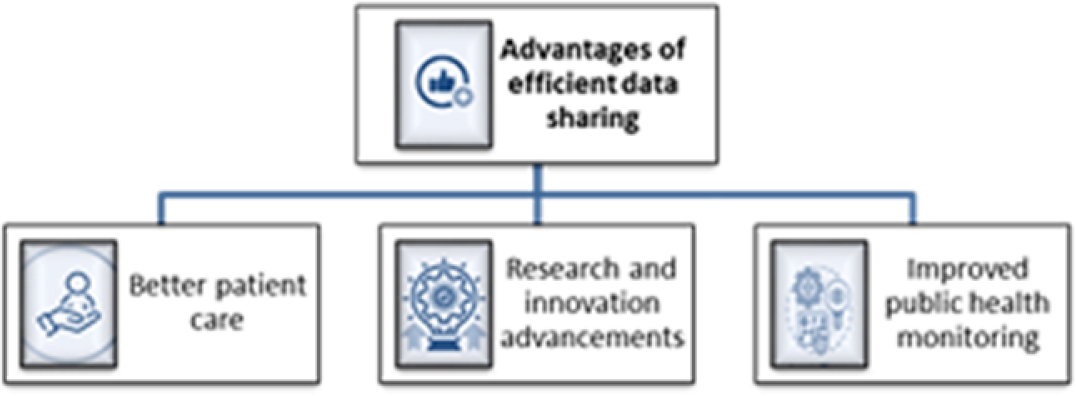
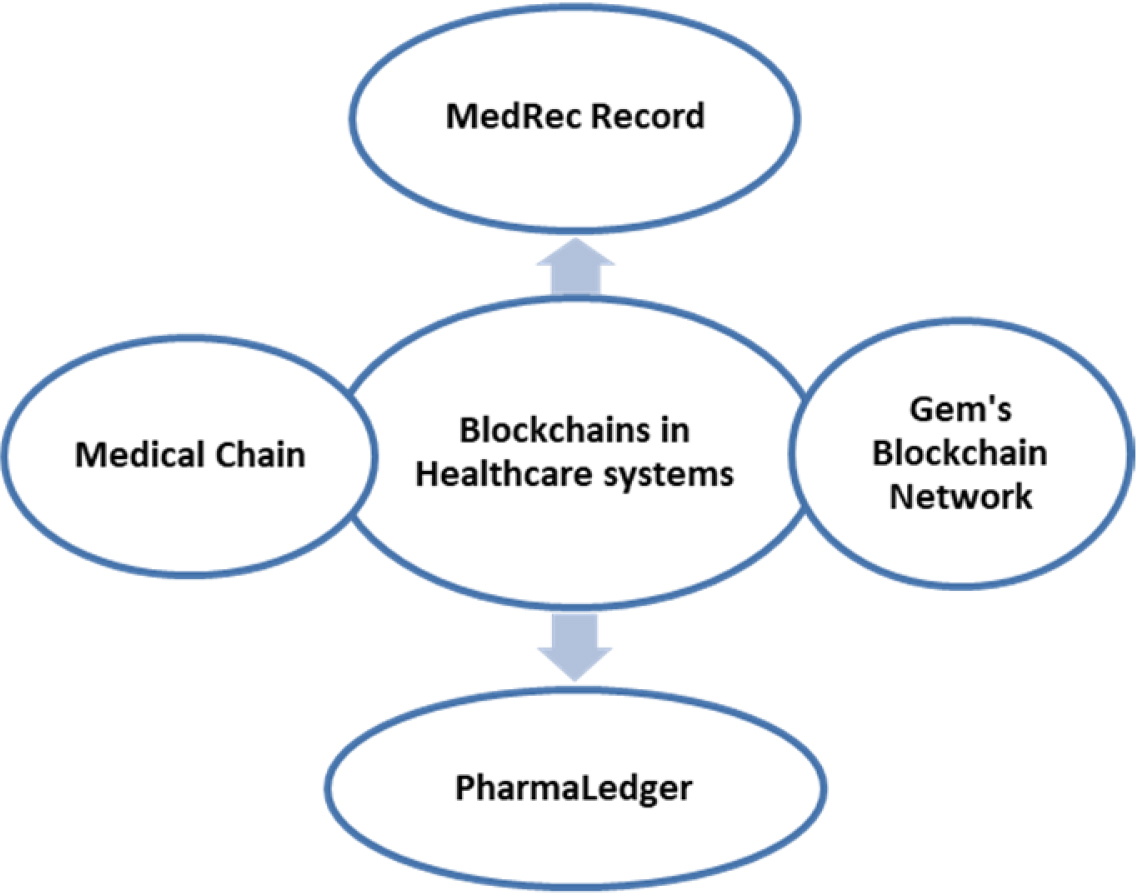
This chapter goes into great detail about the interesting things that blockchain and artificial intelligence (AI) can do for the healthcare business, especially when it comes to safely sharing health data. It shows how important it is to share health information safely in today’s healthcare systems and that old methods do not always work. It also discusses how AI may help with handling healthcare data, which makes it easier to analyze and understand data, and thus make decisions. The chapter uses real-life examples to show how blockchain and AI can work together. For example, it shows how AI can improve sharing health data on the blockchain by adding features such as dynamic consent management and predictive analytics. It also talks about important topics such as ethics, permission, data security, scalability, interoperability and new industry standards. The chapter also looks ahead and imagines how blockchain and AI could make it easier to share healthcare data by making it easier to work with other systems, providing AI-driven clinical help, managing identities in a decentralized way and having strong rules. Finally, it stresses how important it is to involve all stakeholders in this changing path towards a data-driven future in healthcare, while also sharing how safe health data exchange could change the way healthcare works and the entire industry. In today’s rapidly changing healthcare system, sharing and exchanging patient data is very important for providing care that is effective, efficient and patient-focused. Blockchain and artificial intelligence (AI) are two new technologies that make it easier to send health data safely. The rise of this new technology makes these changes easier (Tagde et al. 2021). In this digital age, healthcare is no longer limited to just one hospital or clinic. A lot of different hospitals, professionals and providers treat patients, which creates a network of healthcare data. There are a number of reasons why approved stakeholders must share sensitive information in a safe way. Secure health data exchange lets doctors and nurses see all of a patient’s medical history, which helps them make better and more personalized treatment decisions. In the end, this makes therapy better and helps patients more. Quick access to data makes it easier for healthcare professionals to work together on patients with complicated conditions. This cuts down on unnecessary tests, stops medications from interacting with each other and makes it easier for patients to switch between different types of treatment. Combining health data from different sources also means medical research and innovation is better, which changes how health problems are treated and prevented and how treatment is provided. Quick data exchange is needed for keeping an eye on epidemiological trends, dealing with outbreaks and handling public health emergencies (Lee et al. 2022). Sharing healthcare data in the past has caused a number of problems and issues, such as relying on old paper records and computer systems that do not work together. It is easy to break the law and gain access to, change or mess with paper records. But if electronic systems do not have enough protection, they could be hacked and data could be stolen (Seh et al. 2020). Different healthcare professionals may use electronic health record (EHR) systems that do not work well together, which makes problems worse. Data fragmentation makes it very hard to give patients consistent therapy. It is harder to protect patient privacy and get consent when information is shared by many groups. Managing rights in the traditional way may not work, which could lead to mistakes and wasted time. This makes it harder for healthcare professionals to talk to each other, especially when it comes to making sure that data are accurate and that interoperability standards are met (Ozair et al. 2015). This chapter will look at how blockchain and AI could help to reduce the risks and problems that come with sharing healthcare data. We want to show how blockchain can protect data, stop changes and build trust in healthcare settings, as well as how AI can make blockchain better by helping healthcare professionals analyze, interpret and make decisions about data more effectively. We will look at real-world examples of how blockchain and AI are used, finishing the chapter with suggestions for further reading. As healthcare changes quickly, it is more important than ever to share health data safely. The amount of healthcare data being created is growing very quickly. The growth could be due to better medical technology, putting patient data online, the increase in wearable devices and the ability to combine information from different healthcare sources. The large amount of data coming in, such as patient histories, genetic information, medical imaging and clinical records, shows how important it is to have safe ways to communicate (Negro-Calduch et al. 2021). Figure 17.1 shows some of the benefits of transferring data correctly. The smooth exchange of healthcare data has many benefits, which shows how important it is in modern medicine. Figure 17.1. Advantages of efficient data sharing When healthcare professionals have access to all relevant information, they can get a full picture of a patient’s medical history and current health. With this information, they may be able to make better, more individualized treatment choices, which will lead to better outcomes for patients. Because it is easy to share data, the quality of care stays the same whether a patient sees their primary care doctor, a specialist or receives treatment at another facility (Adane et al. 2019). Combining health data from different sources is very important for making progress in medical research and new ideas. Researchers can use large databases to find patterns in diseases, see how well treatments work and come up with new ways to treat them. This study helps not only the patients who take part, but it also adds to the body of medical knowledge and makes healthcare better (Dash et al. 2019). In order to keep an eye on and fix public health problems, it is very important to share complete and up-to-date health data. This lets administrators quickly take steps to stop the spread of illness, keep an eye on how it spreads and find outbreaks. It plays a big role in managing chronic diseases by making sure that patients get the right treatment for their health (Edelstein et al. 2018). It may be very hard to share health information safely and securely. There are a number of significant problems in this area. Healthcare data often contain private information about a person’s medical history, illnesses and treatments. To maintain patient trust in the healthcare system, it is important to protect patient privacy. People who gain access to this information without permission could hugely violate people’s privacy, which could have a hurtful impact on people, making them less trusting of medical institutions. As medical records have become digital, protecting data has become very important (Nass et al. 2009). Cyberattacks happen more often on EHRs and healthcare databases. Data breaches put both patients and healthcare professionals at a huge risk since they could lead to the theft of personal information, financial fraud or changes to medical records. Getting permission from patients to share data can be very hard, especially when the data have to pass through a lot of different systems and companies. Patients need to be able to control who can see their health information and why they can see it (Yeo et al. 2022). To do this, there needs to be strong permission-management protocols in place. The existing problems and the greater need for sharing health data show that new ideas are needed. Blockchain and AI are two new technologies that could change how medical data are managed by making sure they are private and can be shared quickly. The next sections will look at how AI and blockchain technology could help to manage the problems safely and quickly, with a focus on the patient sending healthcare data (Tagde et al. 2021). Blockchain technology could change a lot of industries, including healthcare, in a big way. Blockchain is basically a ledger system that is not controlled by one person. It is unique because it is decentralized and cannot be changed (Gad et al. 2022). Blockchain is different from traditional centralized systems because it works on a network of decentralized computers called nodes. A centralized system stores all of its data on one server and is run by a central authority. Blockchain uses a peer-to-peer network, which means that each node can help keep an eye on and confirm transactions. There are blocks in this system, and each block contains a piece of data. The fact that blockchain is decentralized is what makes it special. When something is decentralized, it means that there is not one person or group in charge of the whole network. On the other hand, data are spread out over many nodes and checked, which makes the data more durable and harder to change. Because no single group can change the system, the lack of a central authority encourages openness and trust among members. One more important thing about blockchain is that it cannot be changed. Adding data to a block makes it very hard to change or delete, which creates a chain of information that cannot be changed. There is a reference (or hash) to the block before it in each block, which makes the chain unbreakable. The strong cryptographic methods used means that changing one block requires all blocks that come after it to be changed, making it very difficult (Yaga et al. 2019). In the field of healthcare data, blockchain technology has a number of important benefits. It protects the accuracy of healthcare data by making sure it does not change. Blockchain technology makes patient histories, test results and EHRs safe and unchangeable. This means it is much less likely that people will commit fraud or make changes without permission. This information is stored safely on many nodes and is encrypted, which keeps it safe. It is very hard to obtain unauthorized access or carry out data breaches because an attacker has to break into multiple nodes at once, which is hard to do because the system is decentralized and encrypted. Blockchain could make it easier for different healthcare professionals and systems to talk to each other. By providing a standardized and safe way for data to be shared, it reduces the fragmentation that is common in traditional healthcare information systems. This interoperability makes it easier for different healthcare organizations to share data and talk to each other (Shi et al. 2020). Figure 17.2 shows some real-world examples of how blockchain is used in healthcare systems. Figure 17.2. Various real-world blockchains in the healthcare system The MedRec project, created by MIT researchers, looks into how blockchain technology can be used to create a patient-centered, decentralized EHR system. MedRec allows patients to maintain the highest levels of privacy and security, while still allowing healthcare to take place (Ekblaw et al. 2016). Medicalchain is a blockchain network that lets people safely store their medical records and gives healthcare professionals access to them when required. It strengthens the connection between patients and providers by making sure that data are correct, making telemedicine consultations easier, and making medical billing easier (Capece and Lorenzi 2020). Gem, a well-known name in the blockchain field, has created a network specifically for the healthcare industry. This network helps with a number of healthcare problems, such as managing the supply chain, processing claims and checking doctors’ credentials. Gem uses blockchain technology to make healthcare processes safer, more reliable and more open (Ghosh et al. 2023).
17
Enhancing Health Data Security and Intelligence with Blockchain and Artificial Intelligence
17.1. Introduction
17.2. The need for secure health data sharing
17.2.1. Better patient care
17.2.2. Research and innovation advancements
17.2.3. Improved public health monitoring
17.3. Privacy concerns and security constraints
17.4. Blockchain technology
17.4.1. MedRec record
17.4.2. Medicalchain
17.4.3. Gem blockchain network
17.4.4. PharmaLedger
Related posts:
 AI-driven Imaging in Oncology and Physiotherapy: A Game-changer in Diagnostics
AI-enhanced Virtual Rehabilitation: The Future of Cancer Recovery
Integrating AI with Physiotherapy to Improve Quality of Life for Cancer Patients
Personalized AI-based Exercise Therapy for Oncology and Physiotherapy Patients
AI-driven Motion Analysis for Physiotherapy in Cancer Survivors
AI-driven Imaging in Oncology and Physiotherapy: A Game-changer in Diagnostics
AI-enhanced Virtual Rehabilitation: The Future of Cancer Recovery
Integrating AI with Physiotherapy to Improve Quality of Life for Cancer Patients
Personalized AI-based Exercise Therapy for Oncology and Physiotherapy Patients
AI-driven Motion Analysis for Physiotherapy in Cancer Survivors
 AI-driven Innovations in Biomaterial-based Physiotherapy and Oncology: Personalizing Patient Care Through Intelligent Monitoring and Predictive Rehabilitation

Stay updated, free articles. Join our Telegram channel

Full access? Get Clinical Tree


