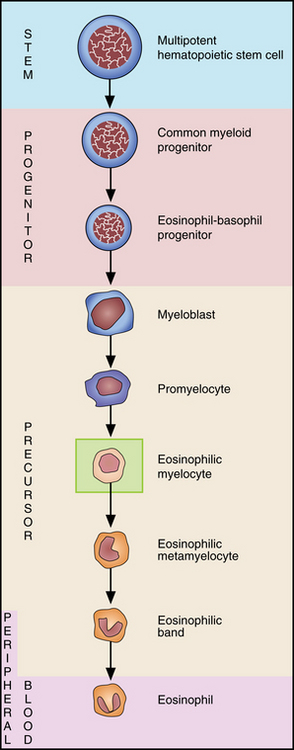
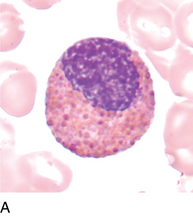
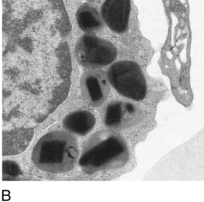
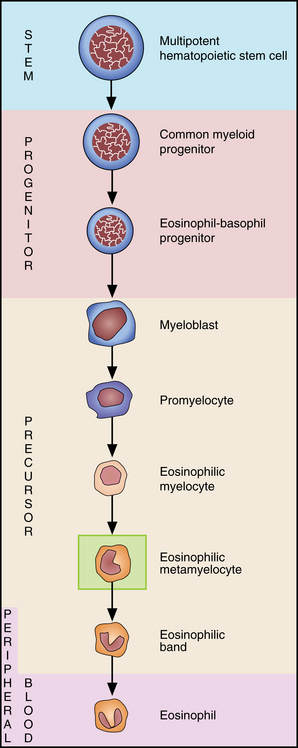
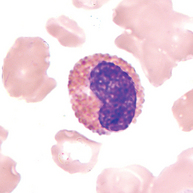
7 Eosinophil maturation FIGURE 7–1 Eosinophilic sequence—eosinophilic myelocyte. Eosinophilic myelocyte FIGURE 7–2A Eosinophilic myelocyte. FIGURE 7–2B Electron micrograph of eosinophilic granules to demonstrate crystalline structure of granules. Size: 12-18 μm Nucleus: Round to oval; may have one flattened side Nucleoli: Usually not visible Chromatin: Coarse and more condensed than promyelocyte Cytoplasm: Colorless to pink Granules: Primary: Few to moderate Secondary: Variable number; pale orange to dark orange; round; appear refractile N/C RATIO: 2:1 to 1:1 Reference interval: Bone marrow: 0% to 2% Peripheral blood: 0% Note: This chapter begins with the image of the myelocyte, rather than the blast, because it is at the myelocyte stage that secondary granules, which define a cell as an eosinophil, first appear. FIGURE 7–3 Eosinophilic sequence—eosinophilic metamyelocyte. Eosinophilic metamyelocyte FIGURE 7–4 Eosinophilic metamyelocyte. Size: Only gold members can continue reading. Log In or Register to continue Share this:Click to share on Twitter (Opens in new window)Click to share on Facebook (Opens in new window) Related Related posts: Hematopoiesis Variations in size and color of erythrocytes Megakaryocyte maturation Nuclear and cytoplasmic changes in leukocytes Neutrophil maturation Body fluids Stay updated, free articles. Join our Telegram channel Join Tags: Clinical Hematology Atlas Jun 12, 2016 | Posted by admin in HEMATOLOGY | Comments Off on Eosinophil maturation Full access? Get Clinical Tree